

The federal earned income tax credit (EITC) provides a refundable tax credit to taxpayers based on their income and family circumstances (such as marital status and number of children). As of January 2026, 32 states and the District of Columbia additionally offered a state EITC. Most state credits are calculated as a percentage of the federal credit.
How do state EITCs differ?
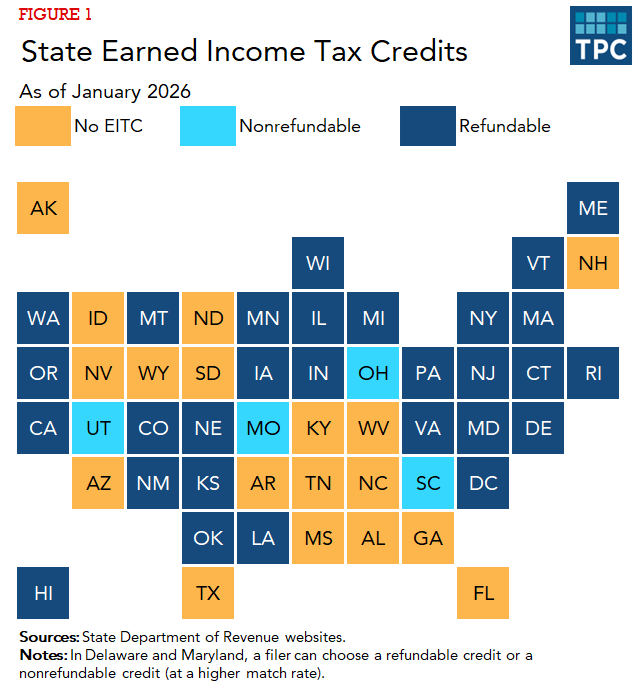
As of January 2026, 32 states and the District of Columbia offered a state EITC. Most recently, Pennsylvania passed legislation to create a state EITC that took effect for tax year 2025.
Data: View and download each state's EITC as a percentage of the federal credit
State EITCs are refundable, like the federal credit, in all but four states: Missouri, Ohio, South Carolina, and Utah. If a refundable credit exceeds a taxpayer’s state income tax liability, the taxpayer receives the excess amount as a payment from the state. In that way, a refundable EITC can offset other state taxes paid by low-income working families, such as general sales taxes. In contrast, a nonrefundable EITC can only offset state income tax liability. Therefore, nonrefundable EITCs typically provide smaller benefits than refundable EITCs for households with lower incomes. The size of the difference varies across state income tax structures, which determine if a household with lower income has sufficient state income tax liability to fully benefit from a nonrefundable credit.
All but three states with a credit (Minnesota, Washington, and Wisconsin) set their EITC as a percentage of the federal credit . As of January 2026, state credit amounts as a percentage of the federal EITC ranged from a refundable 5 percent in Louisiana and Oklahoma to a nonrefundable 125 percent in South Carolina. However, because South Carolina’s credit is nonrefundable, most households eligible for a federal EITC in South Carolina receive little or no benefit from the state’s credit. Among states with a refundable EITC as a percentage of the federal credit, the highest match rates were in the District of Columbia (100 percent), Colorado (50 percent), and Maryland (45 percent). California’s EITC is calculated independently of the federal credit but has a maximum credit amount of approximately 47 percent of the maximum federal credit.
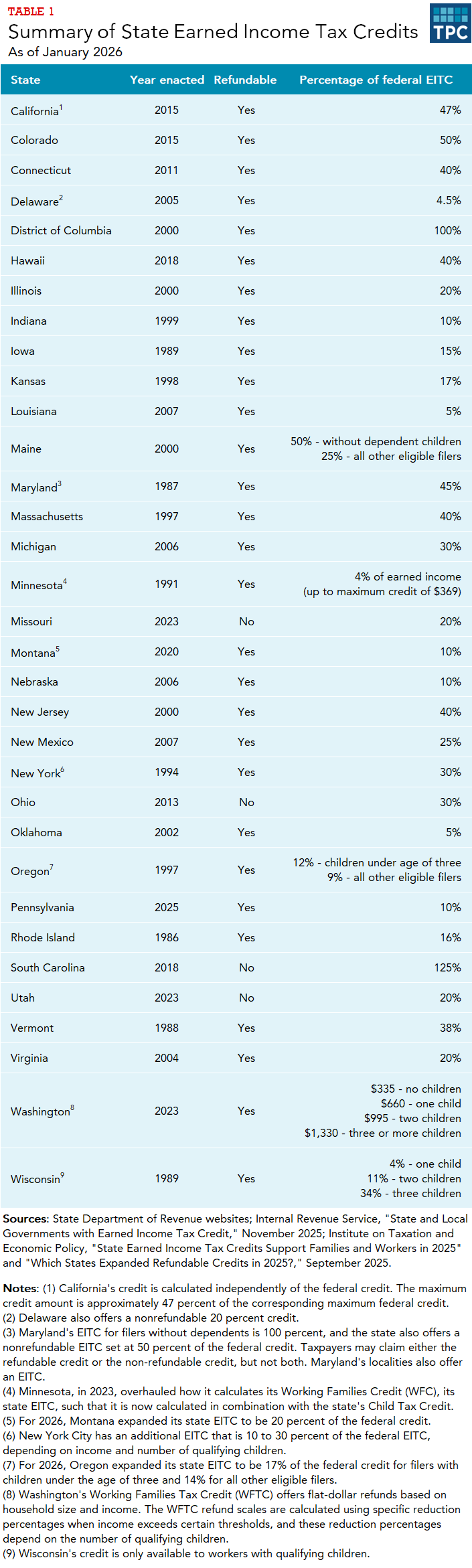
Wisconsin's EITC uses the federal rules but the match rate varies based on the number of qualified children: it is 4 percent of the federal credit for filers with one child, 11 percent for filers with two children, and 34 percent for filers with three or more children. Wisconsin filers without qualifying children cannot claim the state credit. Similarly, Oregon follows the federal rules but offers a higher match rate for filers with children younger than three.
Three states, California , Minnesota , and Washington, do not use the federal EITC rules for calculating their state EITC.
California’s EITC phases in dollar for dollar with the filers’ earnings until it hits a maximum value and then phases out completely at $30,000 of income (for all filing types), which is lower than the federal income eligibility levels. The maximum California EITC for filers with children is roughly 47 percent of the maximum federal credit, but the California and federal calculations differ.
Minnesota also uses a state-specific calculation for its EITC. The Minnesota EITC is 4 percent of earned income, up to a maximum credit value of $379. The state’s EITC amount is calculated in combination with the state’s more generous child tax credit .
Washington state, which does not levy an individual income tax, allows families to claim a set credit amount based on family size ($335 for no children, $660 for one child, and so on) and then reduces the size of the credit based on the tax unit’s adjusted gross income.
How are states reforming the EITC?
Increasingly, states are reforming state EITC rules so that state credits include childless workers and undocumented immigrant workers who receive low or no benefits from the federal EITC..
Childless workers include workers without children, workers with children too old to qualify for the EITC, and workers with children who live with (and are thus on the tax return of) another parent or guardian. Relatively few childless workers are eligible for the federal EITC (because the income eligibility limit for these workers is lower than for workers with children) and those who are eligible receive only a fraction of the benefits available to workers with children. Because most states provide their state credit as a match of the federal credit, state EITCs also provide limited benefits to childless workers.
However, in 2014, the District of Columbia increased its match for childless workers to 100 percent of the federal EITC (the match for filers with children was 40 percent at the time) and expanded the range of eligible income for these filers beyond the federal limits (so some childless filers were eligible for the District's EITC but not the federal EITC). Maine, Maryland , and Vermont have also increased their EITC match specifically for workers without qualifying children.
The federal EITC limits benefits for childless workers to those ages 25 to 64. Colorado, California, the District of Columbia, Illinois, Maine, Maryland, Minnesota, New Jersey, and New Mexico have all made some childless workers younger than age 25 eligible for their state EITC.
The federal rules also require every member of the tax unit to have a valid Social Security number to claim the EITC. Filers without a Social Security number, typically undocumented immigrant workers, instead file taxes with an Individual Taxpayer Identification Number (ITIN). For example, if the children in a household have a Social Security number but the parents file with an ITIN the household cannot claim the federal EITC. In 2020, California and Colorado became the first states to allow ITIN filers to claim their state’s EITC. Since then, the District of Columbia, Illinois, Maine, Maryland, Minnesota, New Mexico, Oregon, Vermont, and Washington have also made ITIN filers eligible for their state EITC.
In addition to changes benefiting childless and undocumented workers, a handful of states have made other age or tax liability-based changes to their state EITCs. Oregon has expanded its credit to 12 percent of the federal EITC for families with dependents under 3 and Ohio’s EITC is limited to 50 percent of families’ tax liability for taxable income over $20,000.
Three states have also made changes so far in 2026 that will go into effect in January 2027. Montana increased its EITC to 20% of the federal credit and Oregon expanded its EITC to be 17% of the federal credit for filers with children under the age of three and 14% for all other eligible filers. Washington changed its eligibility criteria by increasing its income limits and eliminating age restrictions for households without dependents.
Can states that don’t tax income offer an EITC?
In 2021, Washington became the first state without an individual income tax to enact a state EITC . Eligible Washington residents file an application to the state for the credit along with their federal individual income tax return. Filers who are eligible for the federal EITC are also eligible for the Washington EITC, with the state credit amount based on the filer's income and family size.
Updated July 2026
Urban-Brookings Tax Policy Center. 2026. What is the earned income tax credit?. The Tax Policy Briefing Book. Washington, DC.
Boddupalli, Aravind, Luisa Godinez-Puig, Gabriella Garriga, and Harley Webley. 2025. Helping Maryland Connect Underserved Residents to Crucial State Tax Credits. Washington, DC: Urban Institute.
Auxier, Richard C. 2022. How Post-Pandemic Tax Cuts Can Affect Racial Equity. Washington, DC: Urban-Brookings Tax Policy Center.
Maag, Elaine, and David Weiner. 2021. How Increasing the Federal EITC and CTC Could Affect State Taxes. Washington, DC: Urban-Brookings Tax Policy Center.
Maag, Elaine, and Nikhita Airi. 2021. Extending the California Earned Income Tax Credit to Postsecondary Students. Washington, DC: Urban-Brookings Tax Policy Center.
Auxier, Richard C. 2019. District of Columbia Shows How to Expand the EITC For Childless Workers. Washington, DC: Urban-Brookings Tax Policy Center.
Maag, Elaine. 2018. Who Benefits from Expanding the EITC or CTC?. Washington, DC: Urban-Brookings Tax Policy Center.
Rueben, Kim S., Frank Sammartino, and Kirk J. Stark. 2017. Upward Mobility and State-Level EITCs Evaluating California’s Earned Income Tax Credit. Washington, DC: Urban-Brookings Tax Policy Center.