• Experts
  • Events
  • Briefing Book
  • Resources
  • About
  • Contact
  • Support
Twitter
Facebook
RSS
Logo Site
  • Topics
    • Individual Taxes
    • Business Taxes
    • Federal Budget and Economy
    • State and Local Issues
    • Campaigns, Proposals, and Reforms
  • TaxVox Blog
  • Research & Commentary
  • Laws & Proposals
  • Model Estimates
  • Statistics
  • Interactive Tools

The Tax Policy Center's

Briefing Book

A citizen's guide to the fascinating (though often complex) elements of the federal Tax System.

Tax Policy Center Briefing Book

Some Background

  • Chapters
    • Overview
      • Prologue
        • Introduction
    • Some Background
      • The Numbers
        • What are the sources of revenue for the federal government?
        • How does the federal government spend its money?
        • What is the breakdown of tax revenues among federal, state, and local governments?
        • How do US taxes compare internationally?
      • Budget Process
        • How does the budget process work?
        • What is the history of the budget process?
        • What is the schedule for the budget process?
        • What is reconciliation?
        • How is a budget resolution enforced?
        • What is PAYGO?
      • Taxes and the Budget
        • How accurate are long-run budget projections?
        • What have budget trends been over the short and long term?
        • How much spending is uncontrollable?
        • What are extenders?
        • What options would increase federal revenues?
        • What does it mean for a government program to be off-budget?
      • Taxes and the Economy
        • How do taxes affect the economy in the short run?
        • How do taxes affect the economy in the long run?
        • What are dynamic scoring and dynamic analysis?
        • Do tax cuts pay for themselves?
        • On what do economists agree and disagree about the effects of taxes on economic growth?
      • Economic Stimulus
        • What is the role of monetary policy in business cycles?
        • What are automatic stabilizers and how do they work?
        • What characteristics make fiscal stimulus most effective?
      • Distribution of Tax Burdens
        • How are federal taxes distributed?
        • Are federal taxes progressive?
        • How should progressivity be measured?
        • What is the difference between marginal and average tax rates?
        • What criticisms are levied against standard distributional analysis?
        • How should distributional tables be interpreted?
        • Who bears the burden of the corporate income tax?
        • Who bears the burden of federal excise taxes?
        • How do financing methods affect the distributional analyses of tax cuts?
      • Tax Expenditures
        • What are tax expenditures and how are they structured?
        • What is the tax expenditure budget?
        • Why are tax expenditures controversial?
        • What are the largest tax expenditures?
      • Tax Gap
        • What is the tax gap?
      • Tax Shelters
        • What is a tax shelter?
      • History of the Tax Code
        • What did the 2008–10 Tax Stimulus Acts do?
        • What did the American Taxpayer Relief Act of 2012 do?
    • Key Elements of the U.S. Tax System
      • Income Tax
        • What's the difference between tax deductions and tax credits?
        • How do phase outs of tax benefits affect taxpayers?
        • How do the standard deduction and itemized deductions compare?
      • Taxation and the Family
        • What is the personal exemption?
        • Has the personal exemption kept up with prices and incomes?
        • What is the child tax credit (CTC)?
        • What is the adoption tax credit?
        • What is the earned income tax credit (EITC)?
        • How does the tax system subsidize child care expenses?
        • What tax benefits exist for K-12 education?
        • What tax incentives exist to help families save for college?
        • What tax incentives exist to help families pay for college?
        • What are marriage penalties and bonuses?
      • Taxes and the Poor
        • How does the federal tax system affect low-income households?
        • What is the difference between refundable and nonrefundable credits?
        • Can poor families benefit from the child tax credit?
        • Why do low-income families use tax preparers?
        • How does the EITC affect poor families?
        • What are error rates for refundable credits and what causes them?
        • How do IRS audits affect low-income families?
      • Savings and Retirement
        • What kinds of tax-favored retirement accounts are there?
        • How large are the tax expenditures for retirement saving?
        • What are defined-benefit retirement plans?
        • Who uses tax-favored retirement savings accounts?
        • What are defined-contribution retirement plans?
        • What types of nonemployer-sponsored retirement accounts are available?
        • What are Roth individual retirement accounts?
        • How does tax-favored retirement saving affect national saving?
        • What’s the difference between front-loaded and back-loaded retirement accounts?
        • What is an automatic 401(k)?
        • How might low- and middle-income households be encouraged to save?
        • What is the myRA
      • AMT
        • What is the AMT?
        • Who pays the AMT?
        • How much revenue does the AMT raise?
        • Did ATRA fix the AMT?
        • Should the AMT replace the regular income tax?
        • How might we improve the AMT?
      • Tax Complexity
        • Why are taxes so complicated?
        • How costly is complexity?
        • What are the benefits of simpler taxes?
        • What policy reforms could simplify the tax code?
      • Health Care
        • How much does the federal government spend on health care?
        • Who has health insurance coverage?
        • What tax provisions subsidize the cost of health care?
        • How does the tax exclusion for employer-sponsored health insurance work?
        • How does the employer-sponsored insurance exclusion affect health insurance coverage?
        • What are premium tax credits?
        • What is the Cadillac tax?
        • What tax changes did the Affordable Care Act make?
      • Homeownership
        • What are the tax benefits of homeownership?
        • Do existing tax incentives increase homeownership?
      • Capital Gains and Dividends
        • How are capital gains taxed?
        • Why do critics say that corporate income is double-taxed?
        • What is the effect of a lower tax rate for capital gains?
        • How might the taxation of capital gains be improved?
        • What is carried interest, and how should it be taxed?
      • Wealth Transfer Taxes
        • How do the estate, gift, and generation-skipping transfer taxes work?
        • Who pays the estate tax?
        • How many people pay the estate tax?
        • What is the difference between carryover basis and a step-up in basis?
        • How could we reform the estate tax?
        • How should wealth be taxed?
        • What is an inheritance tax?
      • Payroll Taxes
        • What are the major federal payroll taxes, and how much money do they raise?
        • What is the unemployment insurance trust fund, and how is it financed?
        • What are the Social Security trust funds, and how are they financed?
        • Are the Social Security trust funds real?
        • What is the Medicare trust fund, and how is it financed?
      • Federal Excise Taxes
        • What are the major federal excise taxes, and how much money do they raise?
      • Taxes and Energy
        • What tax incentives encourage energy production from fossil fuels?
      • Taxes and the Environment
        • What is a carbon tax?
      • Business Taxation
        • How does the corporate income tax work?
        • What are flow-through enterprises and how are they taxed?
      • Tax Incentives for Economic Development
        • What is the new markets tax credit, and how does it work?
      • Tax-Exempt Organizations
        • How are charitable contributions treated?
        • What entities are tax-exempt as charitable activities?
        • Who benefits from the charitable deductions?
        • How could we improve incentives for charitable giving?
      • International Taxation
        • How does the current system of international taxation work?
        • What are the consequences of the US International Tax System?
        • How does the tax system affect US competitiveness?
        • How would formulary apportionment work?
        • What are inversions, and why do they happen?
        • What are the options for reforming our international tax system?
    • How Could We Improve the Federal Tax System?
      • Incremental Reforms
        • What are ten ways to simplify the tax system?
      • Comprehensive Tax Reform
        • What is comprehensive tax reform?
        • What are the major options for comprehensive tax reform?
      • Broad-Based Income Tax
        • What is it a broad-based income tax?
        • What would and would not be taxed under a broad-based income tax?
        • What would the tax rate be under a broad-based income tax?
      • National Retail Sales Tax
        • What is a national retail sales tax?
        • What would and would not be taxed under a national retail sales tax?
        • What would the tax rate be under a national retail sales tax?
        • What is the difference between a tax-exclusive and a tax-inclusive sales tax rate?
        • Who bears the burden of a national retail sales tax?
        • Would tax evasion and avoidance be a significant problem for a national retail sales tax?
        • What would be the effect of a national retail sales tax on economic growth?
        • What transition rules would be needed for a national retail sales tax?
        • Would a national retail sales tax simplify the tax code?
        • What has been the state and local experience with retail sales taxes?
        • What is the experience of other countries with national retail sales taxes?
        • Why wouldn't the rate for a national retail sales tax be 23 percent?
        • What did the President’s Advisory Panel on Tax Reform say about the national retail sales tax?
      • Value Added Tax
        • What is a VAT?
        • How would a VAT be collected?
        • What would be taxed under a VAT?
        • What would the rate be under a VAT?
        • What is the difference between zero-rating and exemption a good in the VAT?
        • Who would bear the burden of a VAT?
        • Is the VAT a money machine?
        • How would small businesses be treated under a VAT?
        • What is the Canadian experience with a VAT
        • Why is the VAT administratively superior to a retail sales tax?
        • What is the history of a VAT?
        • How are different consumption taxes related?
      • Flat Tax
        • What is the flat tax?
      • X-Tax
        • What is the X-tax?
      • Recent Comprehensive Tax Reform Proposals
        • Simple, Fair, and Pro-Growth: Proposals to Fix America’s Tax System, Report of the President’s Advisory Panel on Federal Tax Reform, November 2005
        • The Moment of Truth: Report of the National Commission on Fiscal Responsibility and Reform, December 2010
        • Debt Reduction Task Force, Restoring America's Future, Bipartisan Policy Center, November 2010
        • The Tax Reform Act of 2014: Fixing Our Broken Tax Code So That It Works for American Families and Job Creators, House Ways and Means Committee
        • The Graetz Competitive Tax Plan: Update for 2015
      • Return-Free Filing
        • What is it return-free filing and how would it work?
        • What are the benefits of return-free filing?
        • What are the drawbacks of return-free filing?
        • How would the tax system need to change with return-free filing?
        • Who would qualify for return-free filing?
        • Would return-free filing raise taxes?
        • What was the experience in California with return-free filing?
        • What other countries use return-free filing?
    • The State of State (and Local) Tax Policy
      • State and Local Revenues
        • What are the sources of revenue for state governments?
        • What are the sources of revenue for local governments?
      • Specific State and Local Taxes
        • How do state and local individual income taxes work?
        • How do state and local sales taxes work?
        • How do state and local property taxes work?
        • How do state and local corporate income taxes work?
        • How do state estate and inheritances tax work?
        • How do state earned income tax credits work?
      • Fiscal Institutions and Intergovernmental Relations
        • How does the deduction for state and local taxes work?
        • What are municipal bonds and how are they used?
        • What types of federal grants are made to state and local governments and how do they work?
        • What are state rainy day funds, and how do they work?
        • What are tax and expenditure limits?

What are the largest tax expenditures?

Tax Expenditures

<4/4
Individual Taxes
Q.

What are the largest tax expenditures?

A.

Tax expenditures make up a substantial part of the federal budget. Some of them are larger than the entire budgets of the programs or departments that spend money for the same or related purposes. For example, the value of the tax breaks for homeownership exceeds total spending by the Department of Housing and Urban Development.

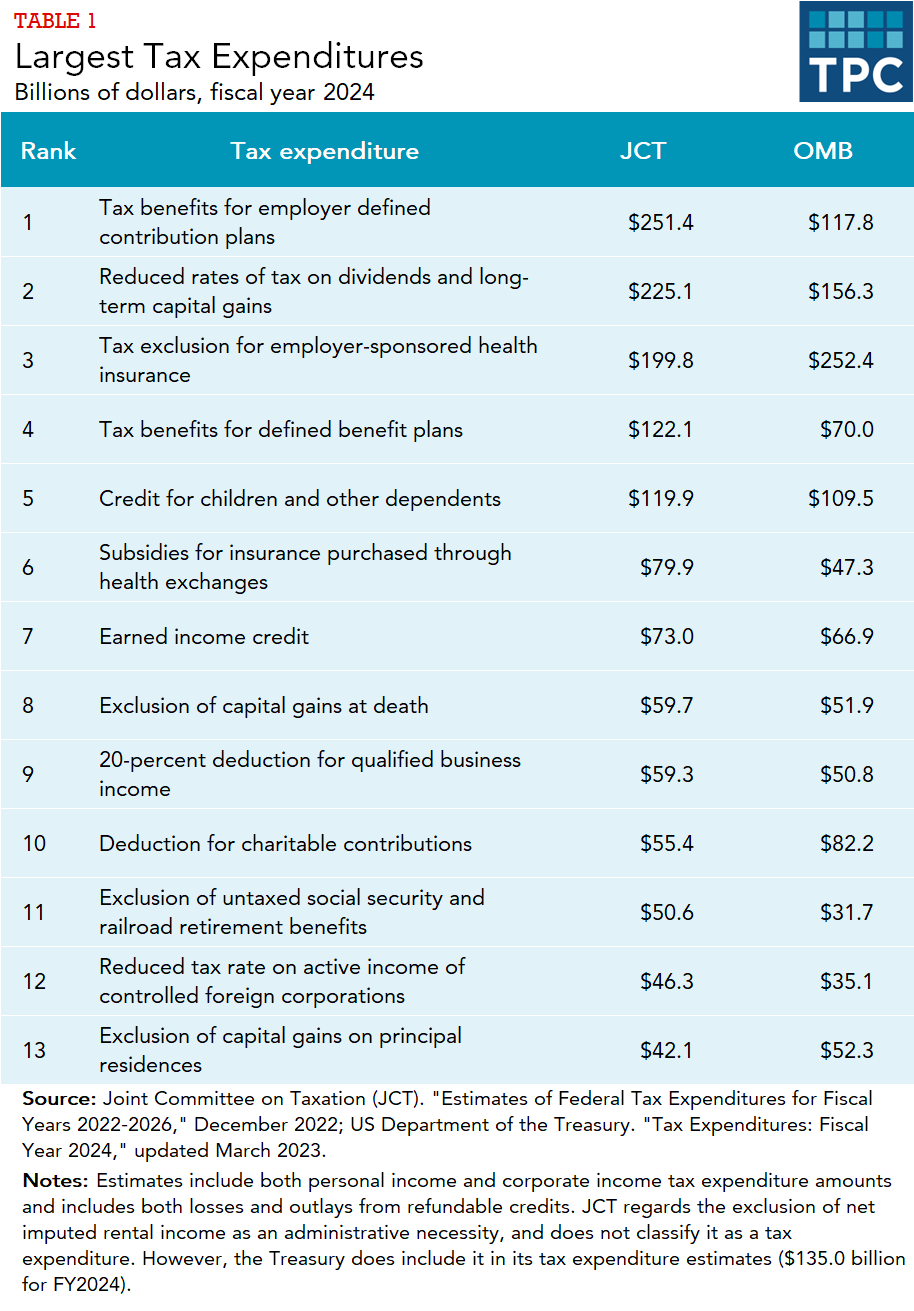
Table 1 ranks the top 13 US tax expenditures. The largest (an estimated $216 billion in 2016) is the exclusion of employers’ contributions for employees’ medical insurance premiums and medical care. Under this provision of the tax code, contributions are excluded from an employee’s gross income, while an employer may deduct the cost as a business expense.

The next largest tax expenditure ($93 billion in 2016) is the preferential rate structure for individuals’ capital gains income, which is taxed at rates ranging from 0 to 20 percent compared to individual income tax rates that range from 10 to 39.6 percent. Capital gains also benefit from the step up in basis at death ($67 billion in 2016), which permanently exempts all unrealized capital gains accrued during an individual’s lifetime on assets that are passed on at death.

Retirement saving also benefits from very large tax expenditures. Investment income earned within tax-qualified saving accounts is tax free. In addition, with most tax-qualified retirement saving accounts, the tax on contributions is deferred until withdrawal at retirement, when a taxpayer is usually in a lower tax bracket. The revenue losses from this preference in 2016 are estimated to total $74 billion for “defined-contribution” plans such as individual retirement accounts and 401(k) plans, and $46 billion for traditional defined-benefit plans sponsored by employers.

Housing benefits from a number of tax preferences. The largest ($82 billion in 2016) is the exclusion of net imputed rental income, which is the return on housing equity in the form of rent-free housing. Housing also benefits from the home-mortgage interest deduction ($75 billion), the deduction for nonbusiness property taxes, and the exemption of the first $500,000 of capital gains for couples ($250,000 for singles) on the sale of principal residences.

Three of the largest tax expenditures mainly benefit low- and middle-income families: the earned income credit ($64 billion in 2016), the child credit ($46 billion in 2016), and the refundable premium assistance tax credit enacted under the Affordable Care Act ($43 billion in 2016). Most budgetary costs from these provisions come in the form of credits that exceed income tax liability and are counted as spending in federal budget totals.

The Office of Management and Budget (OMB) divides deductions of charitable contributions into three buckets: donations to nonprofit educational institutions, to nonprofit health institutions, and to all other organizations. The third, catch-all category benefits from a $47 billion tax expenditure. Combining the deductions for all three categories would raise its ranking in table 1.

In general, tax expenditures for individuals are larger than tax expenditures for businesses. Only one business tax expenditure makes the 2016 top-13 list—the deferral of income from controlled foreign corporations ($67.6 billion in 2016). Among other business tax expenditures, the largest in 2016 are the deduction for US production activities ($15.2 billion), the credit for low-income housing expenditures ($7.9 billion), and the expensing of research and experimentation outlays ($7.2 billion).

Over the 10-year budget horizon, one of the larger tax expenditures is the provision that allows for accelerated depreciation of certain machinery and equipment. This provision allows companies to defer the payment of tax by deducting the cost of equipment over a shorter time period than the property’s likely economic life.

The tax expenditure for this provision was less than $5 billion in 2016 and was actually negative in 2015, reflecting that even more generous rules were in effect through the end of 2014. Until then, companies were allowed to deduct either all or 50 percent of the cost of equipment placed in service in selected years. These prior-year deductions have reduced the amount of depreciation firms can claim in the next few years on assets placed in service before January 1, 2015. Nonetheless, over a 10-year horizon, the provision will cost more than $300 billion.

The figures on accelerated depreciation illustrate how computations of annual revenue losses do not accurately measure the amount of subsidy a tax expenditure actually provides when the provision operates mostly by changing the timing of tax liability. For this reason, OMB also publishes a table showing the “present value” of tax benefits from a single year’s use of selected provisions.

The table in the 2016 OMB report shows, for example, that the present value of tax saving to businesses from accelerated depreciation of the investments in machinery and equipment was $12 billion in 2014. By contrast, the conventional (revenue loss) measure of the same tax expenditure in 2014 was negative (-$9.4 billion), reflecting higher taxes paid on income from prior-year investments from the acceleration of deductions in earlier years.

Data Sources

Office of Management and Budget. Budget of the U.S. Government, FY 2010, Analytical Perspectives. Table 19.1.

Further Reading

Burman, Leonard E., Christopher Geissler, and Eric J. Toder. 2008. “How Big Are Total Individual Income Tax Expenditures, and Who Benefits from Them?” Discussion Paper 31 Washington, DC: Urban-Brookings Tax Policy Center.

Marron, Donald, and Eric Toder. 2013. “Tax Policy and the Size of Government.” Washington, DC: Urban-Brookings Tax Policy Center.

Rogers, Allison, and Eric Toder. 2011. “Trends in Tax Expenditures: 1985–2016.” Washington, DC: Urban-Brookings Tax Policy Center.

U.S. Senate Budget Committee. 2008. Tax Expenditures: Compendium of Background Material on Individual Provisions. Washington, DC: US Government Printing Office.

Individual Taxes
Tax expenditures (individual)
  • ‹Read Previous Why are tax expenditures controversial?
  • Read Next› What is the tax gap?
  • Donate Today
  • Topics
  • TaxVox Blog
  • Research & Commentary
  • Laws & Proposals
  • Model Estimates
  • Statistics
  • Interactive Tools
  • Privacy Policy
  • Newsletters
Twitter
Facebook
RSS
  • © Urban Institute, Brookings Institution, and individual authors, 2016.